New Podcast: Attention Lab
ATTENTION LAB, a 3-part podcast I developed and produced with the School of Radical Attention, premieres today on all platforms. Our first episode focuses on studying attention, and what that can do for us in an age of attention extraction. Please write me if you have a chance to listen; I'd love to hear your thoughts!
Last January, I joined a group of twenty or so strangers in downtown Brooklyn to talk about and practice the art attention. That subject, the venue, and not much else was all I knew going into my first "Attention Lab," a free, in-person workshop hosted by the nonprofit Strother School of Radical Attention. I'd found my way to the group's website via a podcast (Ezra Klein had interviewed one of the school's founders, historian D. Graham Burnett), and I had signed up for the lab because I was resentful of how much time I had been spending on my phone and I was looking for ways to meet new people in New York. I suspected the lab would be a good place to pursue both interests, and if it wasn't, it would be, at minimum, a whimsical way to spend a Saturday. As far as what an Attention Lab would actually entail, I was in the dark.
The motions of that Attention Lab were deceptively simple. We spent a timed minute looking at our own palms, then a minute looking at a partner's hand. We wandered around DUMBO and let our attention lead us wherever it wanted to go: to the waterfront, to the corporatized Time Out food hall, down the cobblestone street where tourists pose for identical pictures in front of the Brooklyn Bridge. We talked about how to define attention, realizing that, for all the talk about how everyone's attention is in crisis, it's actually quite difficult to name what attention is. (Is it something you "pay" or "give"? Is it something you "are"?) But none of these descriptions of what we did that afternoon do justice to how the Attention Lab moved me and how it made me rethink my understanding of general human existence, my work, technology, and storytelling over the next year.
Immediately after the workshop ended—truly, as the chairs were still being folded and stacked—I approached the facilitators about making the School of Radical Attention's curriculum into a podcast. Not another podcast just talking about the problem of attention these days or the digital causes of it, but a podcast that would lead listeners to practice attention, as we had that afternoon. A hybrid lecture and guided activity, as sort of homage to the individual practice of meditation tapes, with collective problems and solutions in mind.
The result is the three part series, ATTENTION LAB. It is a series you can listen to alone, but unlike most podcasts, it's also made to be listened to and practiced with others, whether they be friends, students, family, or any form of community.
We designed the podcast around the three pillars of what the school calls attention activism: studying attention, practicing attention, and building coalition attention. Each episode in the triptych includes all three pillars in the format, beginning with a mini-lecture, then moving into a guided practice, and then including community voices to "fill the empty cup" of attention. (This will make sense when you listen, and I would be so grateful if you would send us a voice memo at strotherschool [at] sustainedattention [.] net!)
Developing and producing this three part series was a top highlight, if not the highlight, of my 2025. This was because I was excited to spend more time with these ideas, but it was mostly because I had wonderful collaborators. I am abundantly grateful to the show's host Raiane Cantisano, whose star power and intellect is through the roof, and School of Attention's program director Peter Schmidt, who offered extremely thoughtful guidance and support throughout the process. And it was an absolute dream to work with the unbelievably skilled Brendan Baker, who sound designed and mixed the series. Before we started on this project, Brendan had told me that he understands sound design as a practice of shaping attention, and we had several conversations since about what it could sound like to shape attention with a non-coercive hand. It really takes someone as gifted as Brendan to shape four minutes of wordless silence in the middle of a podcast with such thought and care. Our team made this podcast in homespun closet studios, in pockets of time late at night and on weekends, and we had a blast the whole way through.
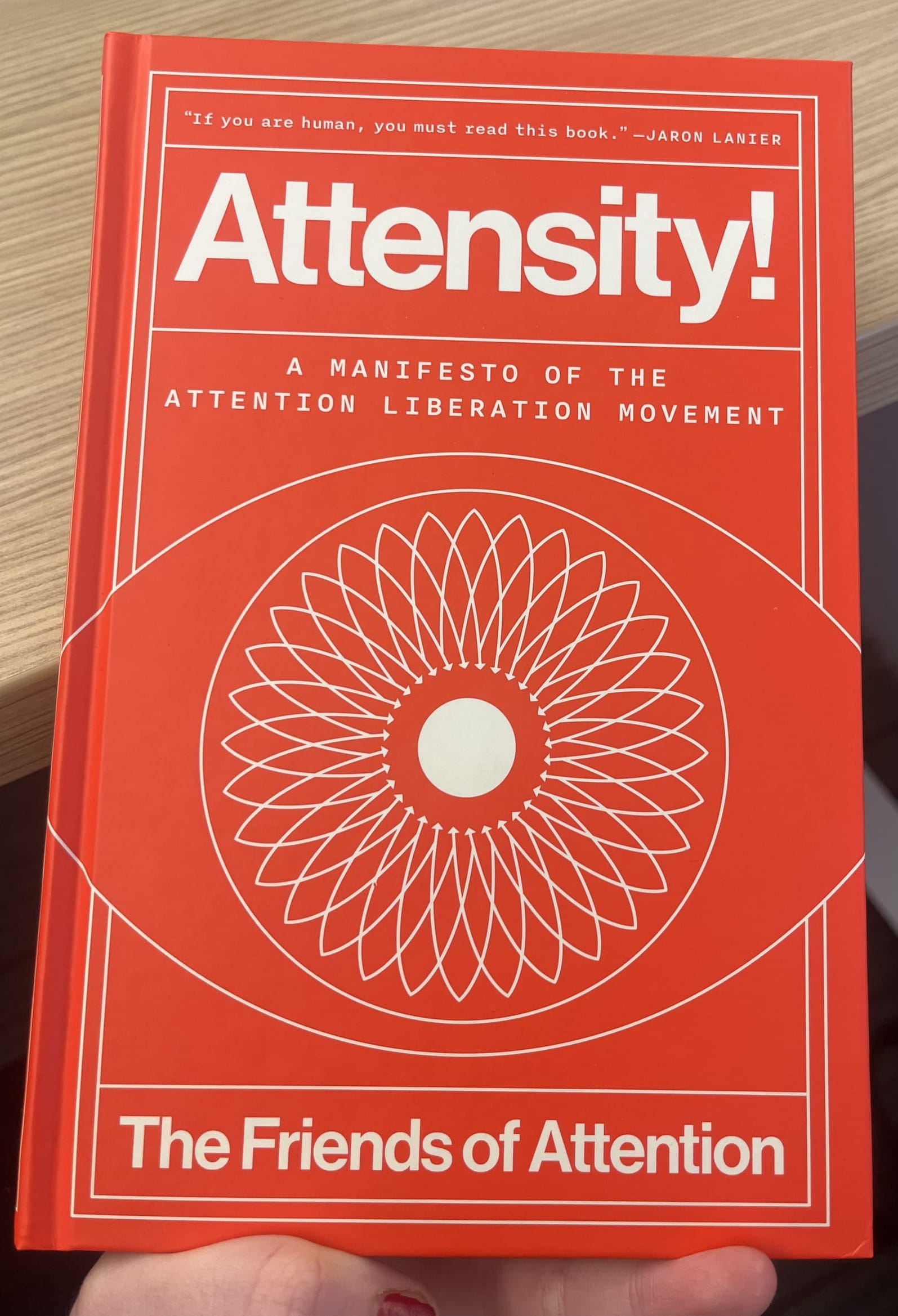
The three part "Attention Lab" podcast is leading up to the January 20th release of Attensity!, a book collectively authored by the Friends of Attention, who launched and organize the school. The book, I can tell you, is very, very good, in the way that you will probably stay in your reading chair until you finish it. (I was not part of the authorship collective, so I can say this in earnest.) Visionary technologist Jaron Lanier, who is most often credited with pioneering the field of virtual reality, said: “Pay attention: If you are human, you must read this book." Chris Hayes of MSNBC and author of The Siren's Call called it "A stirring battle cry on behalf of our shared humanity against the forces that seek to diminish and degrade it. Downright invigorating. Just what the moment calls for.” This is fitting praise for a book that is set up to be a Silent Spring for the threats facing our internal ecologies.
If, in 2025, the liberal discourse around our current crisis of human attention, the technological causes and the political and mental health effects of this crisis, became nearly ubiquitous, the School of Radical Attention—their workshops and classes, their book and this podcast we made—aims to be a tangible, collective effort toward solutions. We mostly hear attention talked about these days in the contexts where it is commodified and turned into a currency: we talk about how hard it is to "pay" attention and talk about how tech companies are "stealing" it for the "attention economy. But the school's central curriculum is about more than what tech companies or politicians are doing to our attention; it's about exploring attention in all of its forms and redefining attention as the inalienable bedrock of human experience.
At this point I should say that, while I initially feared something called the "School of Radical Attention" might be overly precious or Bay Area cultish, it has never felt that way to me at all. After my very first in-person Attention Lab, a group of participants and I went to a nearby brewery to debrief, and we all agreed that it had felt much more grounded than we had expected. The curriculum of the school pulls from many spiritual and political traditions, but at the end of the day, it has the vibe of a school, a community of people who like to learn. My dream for the series, from day one, is that it could be played in a middle or high school somewhere across the country, where young people could take a few moments and think about how their own attention is being shaped, as well as how they might want to shape it themselves.
Over the next few weeks, as the Attention Lab triptych is released, I'll share some accompanying thoughts here about the impact these ideas have had on my individual approach to my own attention, from the perspective of a person trying to tell and take in stories in this current attentional landscape.
Thank you for reading, as ever, and as we say in the show, "thank you for sharing your attention"!