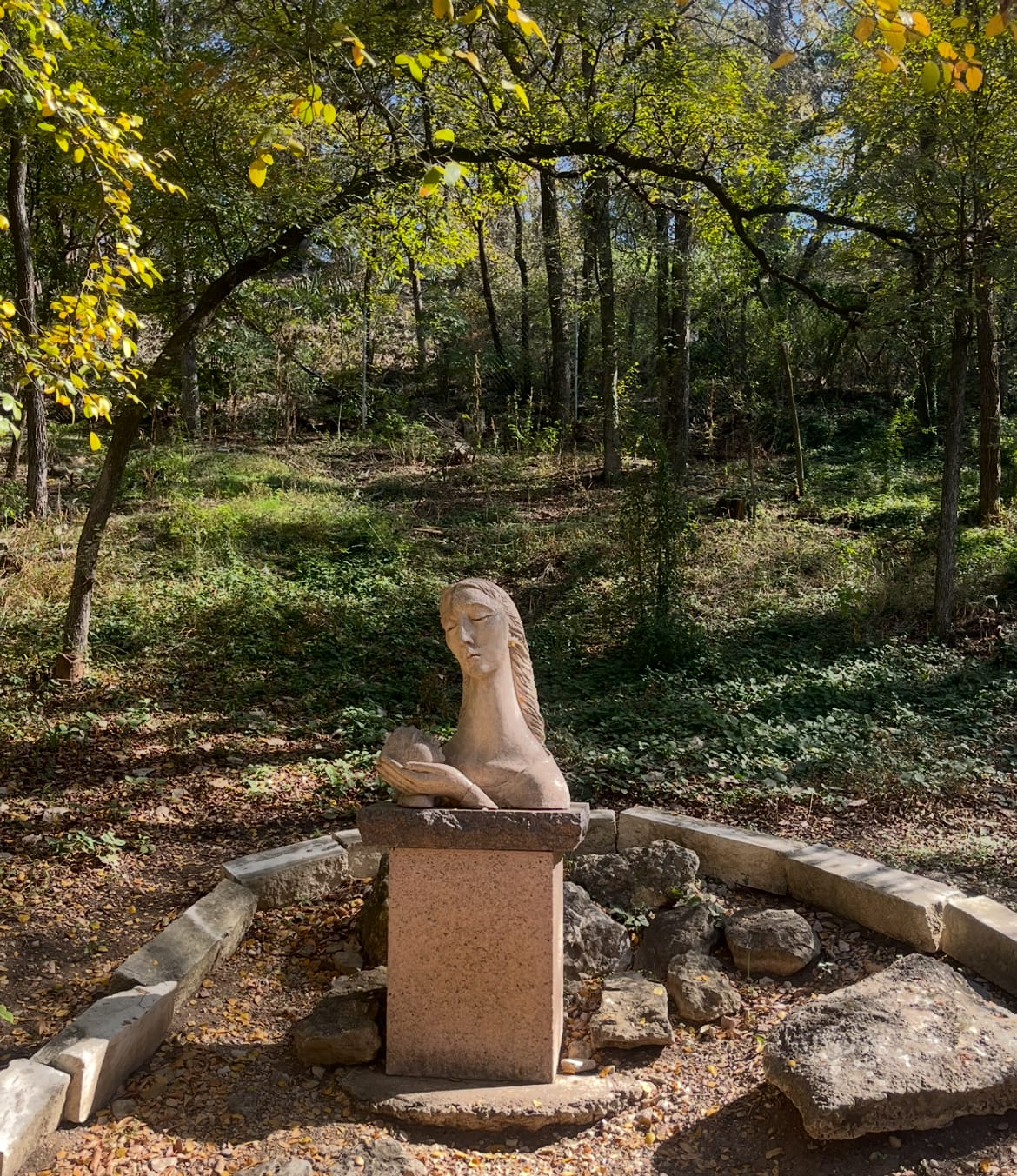
Ghost Story
Hello! I have recently changed newsletter platforms, so you may be seeing this if you were subscribed to me elsewhere. In this letter I explain why and what I hope to do here, now that I've turned my personal website into a blog.
This morning I saw a video online of a possum scaring itself: it creeps up to a mirror, raises its snout to the reflection, then flops, paws in the air, playing dead. I watched it many times, because the force of its flop made me laugh and because I was amazed at how the creature could mistake its own image for a threat. But no, said the comments; if you look closely at the snout in the reflection, it's slightly out of sync with the snout on the possum. I scrutinized the snouts, moving this way, moving that. There is no possum, there is no mirror. Only an impression, a vague echo of possums, matrices of a mirror, pulses in a data center. The realization made me want to flop over, too. We are living in fictional times.
Are you tired? I am tired. It's hard not to be depressed by the ravaged state of our media ecosystems. The Substack orange is remarkably garish. Podcasting, I guess, is short-form video now. Newsletters are Twitter. Everything is a "show". Our platforms are fragile; the robots are coming. Our collective suspension of belief is wearing thin.
And yet, the analog resistance appears to be stirring. My roommates and I have magneted a household Brick on our refrigerator to block all the apps we don't want to use. I recently heard a group of full-time, viral YouTubers are trying to "pivot" into live performance art or in-person readings to protect themselves against digital platform volatility. Last week I joined some neighbors in a Brooklyn living room, where we each brought our own books, poured some tea, and read in complete silence for a timed hour. I'm told the events industry is booming, which I suppose means people want to hang out again. By God, the Luddite gnomes are smashing iPhones outside of the Apple Store!
When confronted with the blaring noise of the internet these days, my first instinct is retreat, to go quiet, to flop over and play dead. What does it mean to be a writer, or to share writing of any sort, in this kind of media landscape? For me, over the past several years, it has meant keeping my writing to myself. A secret case of graphomania. An overabundance of morning pages. A 200k word Word doc, floating in cyberspace.
Here's one magical thing about writing only for yourself: you are not obliged to finish anything at all! You can work yourself into the rapture of rearranging words on a page with the ecstasy of eternally starting new projects. You can outline until the cows come home and then never look at that outline again, instead writing paragraphs of whatever piece you're working on in random notebooks you will never read again. You can have three dozen works in progress and talk about a different one each time someone asks you what you're doing, and then never mention that project ever again. The ego is mutable; language is a living thing. Your rhizome of Word documents and Notions and Scrivener projects can exist between you and whatever mystical divinity might recover the contents of your laptop when you die.
Most of my writing that has been published over the past few years has instead landed on the spectrum of ghost writing, my words transmuted through the voices of various podcast hosts much more widely known than myself. Until earlier this year, I was doing some kind of ghostwriting production and podcast research for my full-time, rent-earning job. My creative and professional lives have both revolved around writing through others, to the point that my roots feel like they have latched onto that ground. As a podcast producer and researcher who is usually not on mic, I have found writing for other people's voices—poets and technologists and comedians and business school professors alike—to be a singular and in many ways rewarding process that necessitates the intimacy of melding with someone else's perspective. Ghostwriting in audio specifically involves a kind of mutual channeling; the ghost writer or producer is at first the medium, giving voice to an host's spirit by writing scripts or interview questions, and then, in the studio, the host becomes the medium, channeling the words on the page in their own voice. The host and the producer take turns giving voice to one another.
There are many perks to being a ghost, especially in this media environment. It is a blessing to avoid perception. If one likes to write, writing can be enough. Good writing takes time and deliberation, and editorial collaboration bakes these into the process. As a relatively new producer scrambling to make it work, I have been dropped into many random situations and forced to pick up subjects I would otherwise have never spent much time with: the history of the British royal family, the terrifying privacy infractions of emerging neurotechnology, the Moog synthesizer production on the Beatles' White Album. I have spent my twenties thus far trying on voices as far from my own as could be. Through the voices and authorship of primarily older, established male podcast hosts, I have been able to speak on a variety of subjects with an authority I never would have assumed were the words coming through my voice.
Lately, though, I've had the sense I have perhaps become too much of a ghost. Once I spent enough time with private phrases of my own and public phrases for others, I started to experience a strange schism in my words. I got used to representing other people through my writing, to the point that sometimes when I read my writing back, it no longer felt like a reflection of me. Jump scare, flop over, paws in the air. Assuming another's authorship allows you to assume their authority, but when you return to yourself, you can't take that authority with you. Once you've become a ghost, it's hard to go back to being a human. You might try to channel yourself for an audience, but you fear the audience will get bored and complain the medium's a fraud.
The shame of internet writing doesn't take much to fester; I have too many drafts of introductory newsletter posts. I started a Substack earlier this year, and I only got two posts in before having deja vu of a past Twitter addiction. When Twitter became so palpably unusable I could no longer use it, I had been relieved. I really don't want to return to the feed. What I do want is to finish some unfinished projects and get them to a place where I can share them with others. I would like to experiment with being less of a ghost, work on saturating myself just enough to be present and without the consistency pressures of algorithms. My hope is not to rope you into my personal development, but more to rope you into thinking through some ideas and stories with me. I will put some essays here, some audio pieces, the occasional ghost story. I will also publish occasional updates on new projects, podcasts, and events I am behind, dispatches from my routine hauntings. I expect the parameters of these writings to change with time, but this ecosystem will remain my own.
Part of what I want to do here, in this mailing list and in my life more generally, is to fumble my way through questions of how narratives both shape and respond to the current environmental and technological crises. What stories about our relationships to nature and machines have led us to the moment we find ourselves in now? What would it look like to rewild our media and narrative ecosystems, borrowing from how we rewild biological ones? What are stories I can tell, or narrative forms I can trace, that might help us make space for more reciprocal ways of being in the world?
Writing and reading for me, especially in 2025, are practices of pushing the limits of my quality of attention, not the quantity of attention I can generate or dole out. I'm mad about algorithms and I don't want to write for or with them—I do worry about what the Substack social media model is doing to the form of essayistic writing. I spend a decent amount of time on Substack, but the posts I most enjoy on there tend to be lists, many of them lists of things to buy. Ghostwriting may be writing under another name, but allowing tech oligarchs and algorithms to dictate the value of our writing is another form of ghostwriting, another way of erasing the writer before their words can be read. When I am writing these days I am asking for your trust that this effort of mine is indeed human, and I want to maintain a space where that trust can be protected.
So, I am turning my personal website into as direct and independent of a channel as I can. To accompany my ongoing ghost writing projects—both the kinds I do for others and the ones I do just for myself—I will send these occasional writings, which are hosted on Ghost. You can sign up below, and my promise to you is to be intentional with my words and respectful of your inbox.